
Ongoing projects

LEAVITT - PLanetary Exploration. key enAbling magnetic deVices and InvesTigaTions
Funding entity: Spanish State Research Agency. Reference: PID2024-160725OB-I00
Using the acronym "Leavitt," inspired by astronomer Henrietta Swan Leavitt, who is credited with discovering the relationship between the luminosity and the period of Cepheids. This represented a major breakthrough in calculating the distances of variable stars and was probably instrumental in subsequent discoveries such as Hubble's observation of the expansion of the universe, the project aims to contribute to the advancement of magnetic technologies for the new challenges of space exploration, as well as to improved processing and interpretation techniques to identify areas with low magnetic contrast and to optimize in-situ data processing for onboard equipment on Mars and the Moon.
The project aims to join the INTA Quantum Technologies Network, developing quantum magnetometers, aligning the development strategy with the NewSpace philosophy.
The proposed scientific investigations expand the case studies previously conducted by the team to include research in areas that, due to their geological infancy, may provide answers or improve understanding of geodynamic aspects.

MINOTAUR - Magnetic Instrumentation Oriented to the study of Terrestrial planets. Application on the characterization of the Martian sURface and lunar rocks during sample return missions.
Funding entity: State Research Agency, Ministry of Science and Innovation. Reference: PID2020-119208RB-I00
Within the Solar System, Earth is just another member of the group of rocky planets. Therefore, research on the other terrestrial planets in the Solar System can significantly contribute to a better understanding of its origin and evolution.
The MINOTAUR project proposes comparative research on the origin and evolution of the terrestrial planets by studying the magnetic anomalies of their crusts. The primary crust is formed by magmatic processes. Material emerging from the mantle at very high temperatures cools at the surface, and when the planet experiences a magnetic field, this material becomes magnetized as it cools. This crust is subsequently exposed to events such as impacts, further volcanism, and plate tectonics, causing the initial magnetization of the crust to change, and consequently, the magnetic anomalies.
At the technological level, the project addresses the development of two instruments:
AMR - conceived in the context of the EXOMARS 2020 space mission, consisting of a miniaturized and compact magnetometer and gradiometer for exploring the surface of Mars.
MS2 - a susceptometer intended to be an evolved version of the instrument developed in the European NEWTON project for in situ rock susceptibility measurements aboard planetary exploration vehicles.
The project also addresses research into planetary magnetism through the study of terrestrial analogs of Mars and the Moon. This includes conducting magnetic surveys in a wide variety of locations, from basalt craters in Argentina and volcanoes in the Canary Islands to environments such as Río Tinto in Huelva.
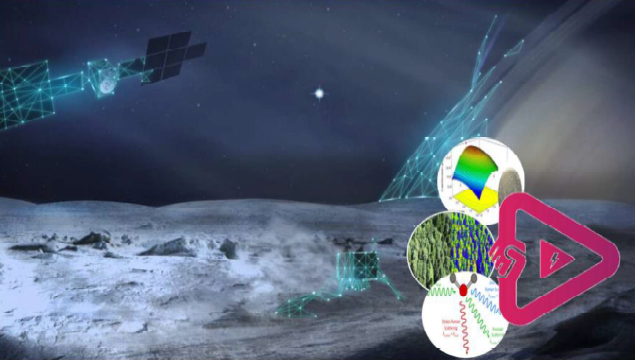
PLUME - PayLoad Universal Methodology for interfacing
Contract: PEA 4000149542 with the European Space Agency.
Following the Cosmic Vision Program, the European Space Agency is proposing new future challenges for the period 2035-2050. Among the missions being considered to address new research that will advance knowledge, in situ research on the icy moons of Saturn is being considered.
These missions require innovative, highly technological solutions to achieve their objectives in the extreme environments of these moons. Ultra-compact, miniaturized systems with ultra-efficient energy management are required. In this context, in the PLUME project, a large team from different INTA departments is focusing on the Touch and Play interface system to maximize the payload in the astrobiological research module through the sequential connection of instrumentation.

Touch & Play
Project funded by the National Institute of Aerospace
Technology Touch & Play addresses a new intelligent and reconfigurable interface system for power, data, and mechanical fixation based on magnetic induction. The device is inherently robust and compatible with harsh environments and facilitates secure communications by generating field emissions.
In the space sector, it is presented as an efficient, highly versatile cutting-edge solution, compatible with modular systems for integration between platforms and payloads, reducing cabling complexity and extending system lifespan.