
Environmental Testing Area

INTA has over 50 years of experience in developing a wide range of environmental tests designed to verify that the mechanical or functional characteristics of a system, or any of its components, are not degraded or adversely affected by the different external environmental conditions to which it may be subjected during its operational life. These conditions depend on the factors characterising its transport, handling, storage and service life.
Environmental testing is a fundamental part of the development, evaluation and certification programmes for any product or material, particularly military and space products. INTA has facilities which are fully equipped with the most advanced instrumentation for simulating climatic conditions in vacuum environments and mechanical conditions — vibration and SRS shock — which can affect not only military and aerospace equipment and systems (on-board equipment, RPAS, vehicles, satellites, rockets or instrumentation and payloads in stratospheric balloons), but also other equipment designed for commercial or civil use.
Numerous pieces of equipment, subsystems and systems developed for aerospace and military projects have been tested at these facilities.
The activity is grouped under the following areas of activity:
- Mechanical testing laboratory
- Climate testing laboratory
ACTIVITIES
CAPABILITIES AND SERVICES
Mechanical Environmental Testing
Among the capabilities and services offered are:
- Vibration testing.
- Classic shock and SRS shock.
- Constant acceleration.
- Determination of mass properties (center of gravity and moments of inertia).
- Calibration of accelerometers.
Accreditation No. 16/LC10.007 is available in accordance with the UNE-EN ISO/IEC 17025:2017 standard, relating to the calibration of accelerometers.
Climatic Environmental Testing
Among the capabilities and services offered are:
- Thermal cycling tests in high vacuum.
- Thermal cycling tests in inert atmosphere.
- Thermal shock tests (rapid thermal cycling).
- Thermoelastic deformation tests in combination with thermal cycling tests.
RESEARCH PROJECTS
The area has successfully participated in multiple research projects, validating climatic and mechanical tests on developments carried out within National Plan projects, as well as European projects. Specifically, the most significant projects in recent years include:
- The Large European Antenna (LEA) project, funded by the European Union's (EU) H2020 programme, for the development of a large deployable antenna, as well as the follow-up programme LEOB.
- ESA's PLATO (PLAnetary Transits and Oscillations of stars) project, both in the development of mechanical tests under ISO 5 conditions for the focal planes of the telescopes and in the thermal cycling tests in vacuum of 10 of the mission's telescopes and two spare units.
- ANSER Programme, Small Satellite Constellations Programme, which aims to create satellite constellations consisting of nanosatellites using the cubesat standard of up to 3 kg mass (3U) flying in formation; as well as in other multiple projects of the National Plan.
FACILITIES - Environmental Testing
The main facilities listed below are available for each of the testing services detailed above:
Mechanical Environmental Testing
| Name | Main Features |
|---|---|
|
DUAL vibration system |
Maximum acceleration: 12 g/s Sliding table dimensions: 3 m x 3 m ISO class 8 |
|
COMBO vibration system |
Maximum acceleration: 30 g/s Sliding table dimensions: 1.5 m x 1.2 m Expander dimensions 1.2 m Ø |
|
COMBO 2 vibration system “CANIS MAJOR” |
Maximum acceleration: 40 g/s Sliding table dimensions: 0.8 m x 0.8 m Expander dimensions 0.8 m Ø |
|
Vertical vibration system |
Maximum acceleration: 26 g/s Expander dimensions 1: 2.3 m x 2.3 m Expander dimensions 2: 1.5 m x 1.5 m |
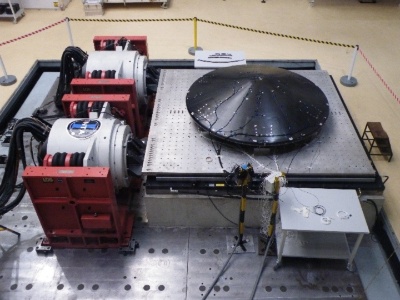
Vibration testing on the DUAL system of the Exomars Shield (AIRBUS DS)
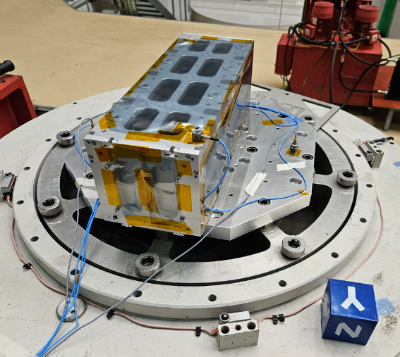
Vibration testing of Cubesat ANSER Project (INTA)
SRS Shock Facilities
| Name | Main Features |
|---|---|
|
Pneumatic SRS system “MESSIER 82” |
Maximum acceleration: 100,000 g/s Maximum specimen dimensions: 300 mm x 300 mm x 300 mm Maximum weight EUT: 45 kg |
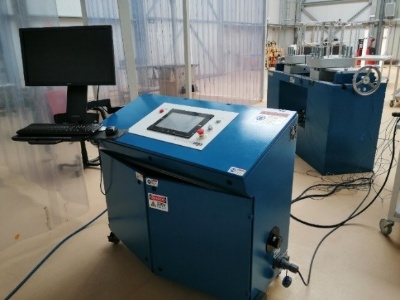
Pneumatic shock system
Mechanical Environmental Testing (Physical properties)
| Name | Main Features |
|---|---|
|
SPIDER 35 scale |
Maximum specimen dimensions: 400 mm x 300 mm Maximum weight EUT: 35 kg |
|
SPIDER 600 scale |
Maximum specimen dimensions: 1,250 mm x 1,000 mm Maximum weight EUT: 600 kg |
|
Centre of gravity measurement system SCHENCK ESE |
Maximum specimen dimensions: Ø 1,000 mm Maximum weight EUT: 60 kg |
|
Centre of gravity measurement system SCHENCK WS 4 |
Maximum specimen dimensions: Ø 1,000 mm Maximum weight EUT: 400 kg |
|
Moment of inertia measurement system SCHENCK M2 |
Maximum specimen dimensions: Ø 500 mm Maximum weight EUT: 40 kg |
|
Moment of inertia measurement system SCHENCK M4 |
Maximum specimen dimensions: Ø 1,000 mm Maximum weight EUT: 400 kg |
Climatic Environmental Testing
| Name | Main Features |
|---|---|
|
CENTAURUS A simulator |
Dimensions: 4 m x 4 m x 4 m Temperature range: -170°C to +150°C Vacuum level: <10-5 Pa Thermoelastic testing capability |
|
ANDROMEDA simulator |
Dimensions diameter: 2 m x 3 m depth Temperature range: -190°C to +150°C Thermal plate: -150º to +150ºC Vacuum level: <10-5 Pa |
|
COSMOS 01 simulator |
Dimensions diameter: 1.3 m x 1.5 m depth Temperature range: -155°C to +150°C Thermal plate: -150º to +150ºC Vacuum level: <10-5 Pa |
|
COSMOS 02 simulator |
Dimensions diameter: 0.8 m x 1 m depth Temperature range: -155°C to +150°C Vacuum level: <10-5 Pa |
|
BIG MAGALLANES |
Dimensions: 1.45 m x 1.42 m x 1.5 m Temperature range: -170°C to +170°C Ambient pressure in a GN2 atmosphere |
|
LITTLE MAGALLANES |
Dimensions: 0.815 m x 0.815 m x 0.535 m Temperature range: -170°C to +170°C Ambient pressure in a GN2 atmosphere |
|
DRACO ATC4 |
Dimensions: 0.280 m x 0.330 m x 0.140 m Temperature range: -180°C to +150°C Ambient pressure in a GN2 atmosphere |
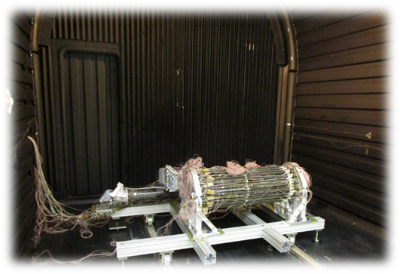
Thermal vacuum test on large deployable antenna LEA H2020 programme
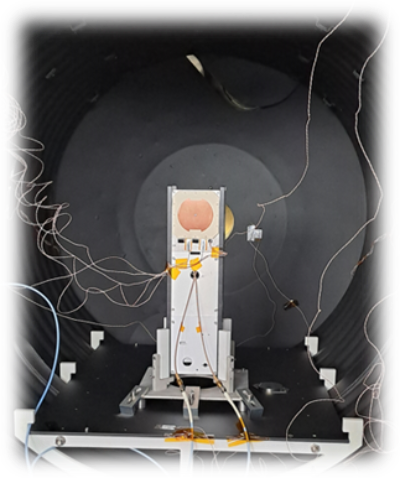
Thermal vacuum test. ANSER programme
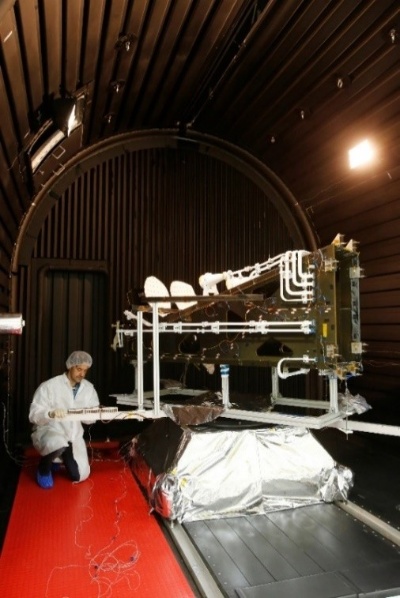
Thermoelastic distortion testing of Feeder SubAssembly (AIRBUS DS)
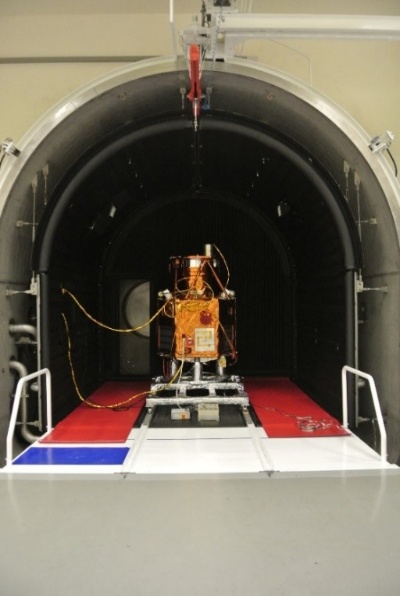
DEIMOS 2 satellite thermal vacuum test
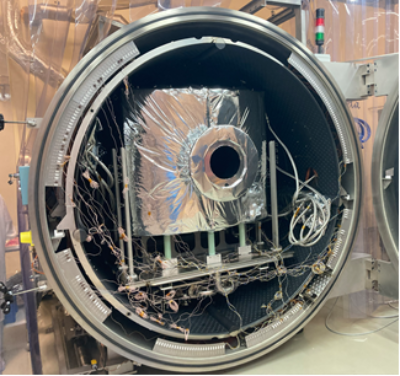
Thermal cycling in TVAC ANDROMEDA – PLATO FM23 programme
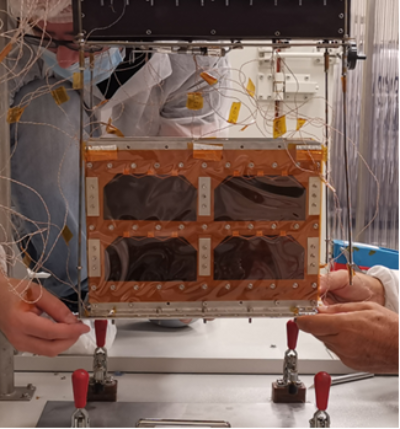
Thermal shock in ‘DRACO-ATC4’ – SPASOLAB Solar Cells (20P024)
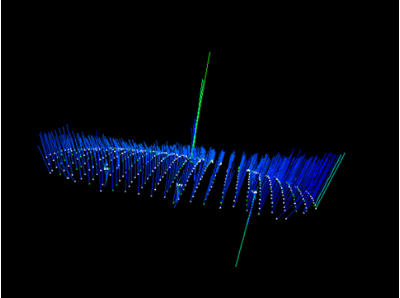
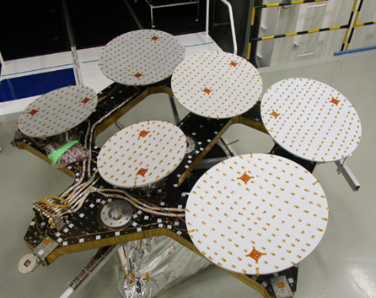
Photogrammetry test on satellite communication system (AIRBUS DS)
Contact - Environmental Testing
 Email*: ensayos.ambientales@inta.es
 Environmental Testing location in Google maps
*By reading and accepting the Privacy Policy and Legal Notice and in compliance with Regulation (EU) 2016/679 of the European Parliament and of the Council of 27 April 2016 and Organic Law 3/2018 of 5 December (LOPDGDD), we inform you that the personal data provided will be processed exclusively for the purposes of your request. The entity responsible for data processing is the National Institute of Aerospace Technology (INTA) located at Ctra. de Torrejón a Ajalvir Km. 4.5. Torrejón de Ardoz. 28850 - Madrid.
The processing of your data is carried out on the basis of Article 6.1.e) of the GDPR, necessary for the fulfilment of a mission carried out in the public interest or in the exercise of the public powers conferred on the data controller. No data will be transferred unless legally required.
You may exercise your rights of access, rectification, erasure, objection, restriction and portability of data free of charge through Sede Electrónica del Ministerio de Defensa, at any official registry office or by emailing dpd@mde.es with a signature validated through the VALIDE platform. Additional information can be found in www.inta.es/INTA/es/politica/politica-de-privacidad/.